

Informing on environment and climate news in Africa
Provided by AGP
Hygiene Components Market to Reach US$ 41.1 Billion by 2033 at 5.9% CAGR | Persistence Market Research
Hygiene Components Market
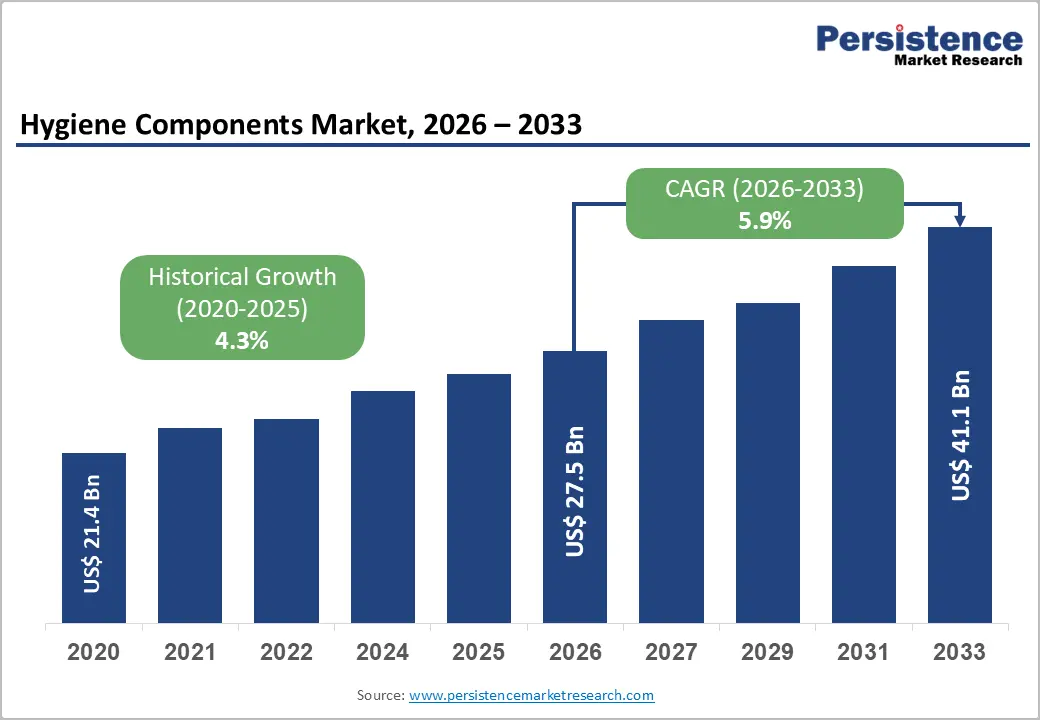
BRENFORD, LONDON, UNITED KINGDOM, May 18, 2026 /EINPresswire.com/ -- The global Hygiene Components Market is gaining steady momentum as hygiene-focused products become essential across personal care, healthcare, baby care, feminine hygiene, adult incontinence, and institutional cleaning applications. According to Persistence Market Research, the market is likely to be valued at US$ 27.5 billion in 2026 and is expected to reach US$ 41.1 billion by 2033, expanding at a CAGR of 5.9% during 2026 to 2033. Growth is supported by rising consumer awareness of cleanliness, infection prevention, skin comfort, and safe absorbent materials.
Market statistics indicate consistent demand from disposable hygiene products, absorbent hygiene solutions, wipes, medical hygiene materials, and sanitary products. The leading segment is expected to remain absorbent and nonwoven-based components due to their wide use in diapers, sanitary napkins, adult care products, and medical disposables. The leading geographical region is likely to be Asia Pacific, supported by population growth, urbanization, rising disposable income, and increasing adoption of branded hygiene products.
Want Market Insights? Get Your Free Report Sample : https://www.persistencemarketresearch.com/samples/36791
Key Highlights from the Report
➤ The global hygiene components market is likely to be valued at US$ 27.5 billion in 2026 and reach US$ 41.1 billion by 2033, growing at a 5.9% CAGR.
➤ Rising demand for disposable hygiene products is increasing the use of absorbent cores, nonwovens, films, adhesives, and elastic components.
➤ Baby care, feminine hygiene, and adult incontinence products continue to create strong demand for advanced hygiene materials.
➤ Asia Pacific is expected to remain a key growth region due to rising hygiene awareness and expanding consumer spending.
➤ Product innovation is moving toward breathable, skin-friendly, sustainable, and high-absorbency hygiene components.
Market Segmentation
The hygiene components market can be segmented by product type into nonwoven fabrics, absorbent cores, films, adhesives, elastics, tapes, fasteners, and other supporting materials. Nonwoven fabrics hold strong importance because they are widely used in topsheets, backsheets, wipes, masks, diapers, sanitary products, and medical hygiene applications. Absorbent cores are also central to the market as they directly influence liquid retention, dryness, leakage protection, and comfort.
By end use, the market includes baby hygiene, feminine hygiene, adult incontinence, healthcare hygiene, personal care, and institutional hygiene products. Baby diapers and feminine hygiene products remain major demand generators, while adult incontinence products are expanding due to aging populations and improved product acceptance. Healthcare hygiene products are also gaining relevance as hospitals, clinics, and care facilities prioritize infection control and disposable hygiene solutions. This broad application base supports long-term market stability.
Regional Insights
Asia Pacific is expected to be a leading region in the hygiene components market due to its large consumer base, increasing urban population, and rising adoption of packaged hygiene products. Countries with expanding middle-class populations are witnessing higher demand for baby diapers, sanitary products, wipes, and adult care solutions.
North America and Europe continue to show mature but steady demand, supported by high awareness of hygiene, premium product adoption, and strong healthcare infrastructure. Consumers in these regions increasingly prefer sustainable, dermatologically safe, and comfort-focused hygiene products. Meanwhile, Latin America and the Middle East & Africa are gradually expanding as hygiene awareness improves and modern retail access increases.
Market Drivers
The main driver of the hygiene components market is rising awareness about personal hygiene, health protection, and infection prevention. Consumers are becoming more selective about product safety, softness, absorbency, breathability, and convenience. This shift is encouraging manufacturers to use better nonwovens, absorbent materials, elastic systems, and skin-friendly layers. Demand is also increasing from working populations, urban households, healthcare facilities, and care institutions.
Another major driver is the growing need for baby care, feminine hygiene, and adult incontinence products. Population growth, lifestyle changes, and aging demographics are creating steady demand across both developed and emerging markets. Adult care products are becoming more accepted as brands focus on discretion, comfort, and dignity. These factors are expanding the role of hygiene components across multiple product categories.
Customize This Report for Your Exact Requirements : https://www.persistencemarketresearch.com/request-customization/36791
Market Restraints
One key restraint is the rising cost of raw materials used in hygiene components, including nonwovens, polymers, adhesives, films, and absorbent materials. Price fluctuations can affect production costs and reduce profit margins for manufacturers. Smaller producers may face difficulty maintaining quality while managing cost pressure. This can limit product affordability in price-sensitive markets.
Environmental concerns related to disposable hygiene products also create challenges. Many hygiene products depend on synthetic materials and generate waste after use. Consumers and regulators are increasingly demanding recyclable, biodegradable, or lower-impact solutions. However, developing sustainable components that maintain absorbency, softness, durability, and affordability remains technically and commercially challenging.
Market Opportunities
The market offers strong opportunities in sustainable hygiene components. Manufacturers can benefit by developing biodegradable nonwovens, plant-based materials, recyclable films, and lower-plastic product structures. Brands that combine performance with sustainability are likely to gain consumer trust, especially in premium and environmentally aware markets. Innovation in lightweight and resource-efficient materials can also reduce production waste.
Unlock Complete Insights – Buy the Full Report : https://www.persistencemarketresearch.com/checkout/36791
Emerging markets provide another major opportunity as hygiene product penetration continues to rise. Growing awareness, improving income levels, and expanding retail networks are increasing demand for affordable and reliable hygiene products. Companies that offer cost-effective components without compromising comfort and safety can strengthen their position. Partnerships with hygiene product manufacturers can further support market expansion.
Company Insights
Key players operating in the hygiene components market include:
• Berry Global Inc.
• Freudenberg Group
• Ahlstrom
• Kimberly-Clark Corporation
• Essity AB
• Fitesa S.A.
• Avgol Nonwovens
• Glatfelter Corporation
• Toray Industries, Inc.
Explore the Latest Trending Research Reports:
Antiseptic and Disinfectant Market
Disposable Aseptic Isolation Systems Market
Persistence Market Research
Persistence Market Research Pvt Ltd
+1 646-878-6329
email us here
Visit us on social media:
LinkedIn
Instagram
Facebook
YouTube
X
Legal Disclaimer:
EIN Presswire provides this news content "as is" without warranty of any kind. We do not accept any responsibility or liability for the accuracy, content, images, videos, licenses, completeness, legality, or reliability of the information contained in this article. If you have any complaints or copyright issues related to this article, kindly contact the author above.
