

Cable Tray Market Global Revenue Climbs to USD 13.33 billion, at a CAGR of 9.5% By Growing Demands, and Trends Till 2035
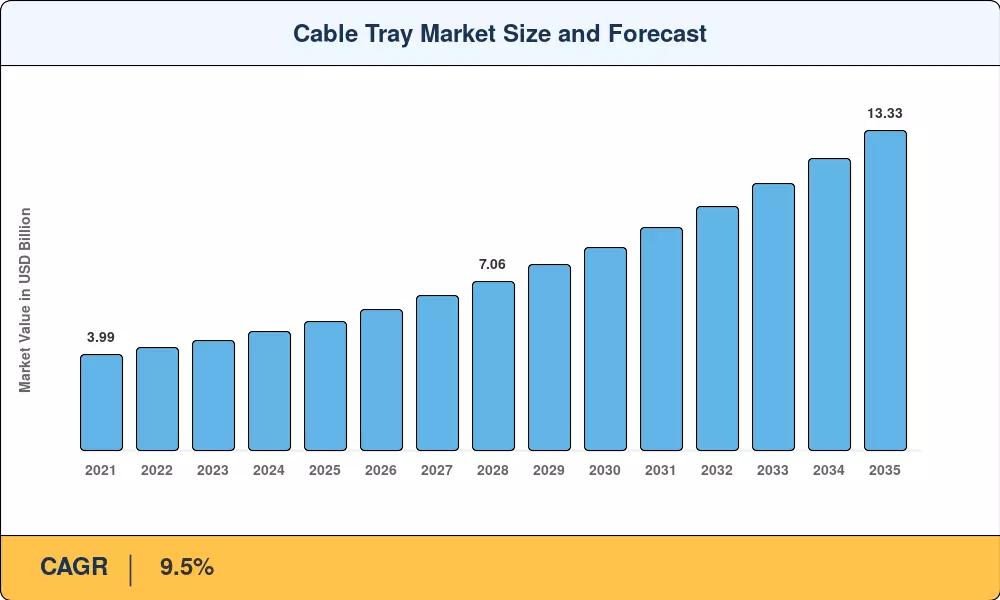
Cable Tray Market Summary
Power and Utilities represent the largest end-user group in the cable tray market, accounting for an estimated USD 2.04 billion in 2025.
Steel remains the backbone of the cable tray market, commanding roughly 48% of global revenue in 2025, thanks to its load-bearing capacity and widespread availability in heavy-industrial environments.”
NY, CA, UNITED STATES, July 15, 2026 /EINPresswire.com/ -- Cable trays are rigid structural systems used to support and organize electrical cables, communication wires, and fiber optic lines in buildings, industrial facilities, and infrastructure projects. They provide a safer, more flexible, and more accessible alternative to traditional conduit systems, enabling better cable management, improved airflow, and easier maintenance. Cable trays are manufactured in various materials including steel, aluminum, and fiber-reinforced polymers (FRP), and are available in ladder, trough, channel, and wire mesh configurations.— Arti Dhapte
Cable Tray Market Overview
The cable tray market share reached an estimated USD 5.38 billion in 2025, setting the stage for a forecast period that begins at USD 5.89 billion in 2026 and climbs to USD 13.33 billion by 2035, expanding at a CAGR of 9.5%. Two forces are doing the heavy lifting here: a global construction boom anchored by urbanization policies across Asia and the Middle East, and a parallel surge in data center investment that JLL projects will bring roughly 10 GW of new hyperscale and colocation capacity online by late 2025 alone, representing an estimated asset value near USD 170 billion.
The market is experiencing robust growth driven by several key factors. Data center capacity expansion is the single biggest short-term driver, with JLL's 2025 forecast indicating around 10 GW of new hyperscale and colocation capacity beginning construction worldwide, representing about USD 170 billion in asset value. Cable trays serve as the foundation for arranging power distribution, fiber optics, and network cabling across these facilities. Each megawatt of data center capacity necessitates extensive structured cabling systems, with the majority of investment absorbed by North America and Europe while Southeast Asia and the Middle East rapidly catch up.
Industry trends indicate a decisive evolution in cable management from legacy conduit-based systems to modular tray architectures that accommodate higher cable densities, easier reconfiguration, and better airflow management. The shift from under-floor to overhead cable routing in data centers has become a structural tailwind, improving cold-aisle airflow by 15-25% and making cable trays the preferred choice over legacy raised-floor approaches. Pre-fabricated cable tray assemblies are gaining traction, reducing on-site labor time by up to 40%.
Technological developments are reshaping the market landscape. Building Information Modeling (BIM) platforms now integrate cable tray routing as a core discipline alongside HVAC and structural engineering, with AI-powered design tools optimizing tray pathways to minimize material usage and installation time by an estimated 10-15%. IoT-enabled cable tray systems embedded with temperature sensors, load monitors, and airflow detectors provide real-time operational data to building management platforms, enabling predictive maintenance and reducing unplanned downtime. The convergence of power and data cabling through Power over Ethernet (PoE) lighting and IoT sensors is creating new product categories with integrated separation barriers and EMI shielding.
Policy and regulatory influence continues to shape market dynamics. The EU's revised Construction Products Regulation (CPR) mandates enhanced reaction-to-fire classifications for cable support systems installed in public buildings, tunnels, and transportation hubs. In North America, updates to the National Electrical Code (NEC) Article 392 continue to raise minimum standards for cable tray fill ratios and grounding. The U.S. Infrastructure Investment and Jobs Act (IIJA) earmarks over USD 65 billion for power-grid upgrades, while Europe's REPowerEU strategy reinforces similar spending commitments.
North America holds the dominant position in the cable tray market with roughly 34% of global revenue, driven by sustained utility infrastructure spending and data center expansion. Asia-Pacific is the fastest-growing region at a CAGR exceeding 11%, fueled by India's smart-city mission and China's 5G rollout. Europe accounts for the second-largest share at approximately 26%, supported by industrial modernization across Germany and the Nordic countries.
Get Free Sample Report for Detailed Market Insights:
https://www.marketresearchfuture.com/sample_request/43041
Cable Tray Market Segmentation
By Material
Steel: Commands roughly 48% of global revenue in 2025, thanks to load-bearing capacity and widespread availability in heavy-industrial environments
Aluminum: Fastest-growing material segment with a CAGR of 10.8% through 2035, favored for corrosion resistance and lighter weight
Fiber-Reinforced Polymers (FRP): Hold approximately 20% share, carving a niche in chemical plants and coastal installations where corrosion is a primary concern
By End-User Industry
Power and Utilities: Largest end-user group, accounting for an estimated USD 2.04 billion in 2025 from substation upgrades, grid expansion, and renewable integration
Construction: Contributes roughly 30% of total demand, propelled by commercial real-estate development and smart-building mandates
Industrial and Other (IT & Telecom, Data Centers, etc.): Fastest-growing segment at 11.3% CAGR, driven by hyperscale data centers, 5G rollout, and factory automation
Competitive Landscape / Key Players
The cable tray market exhibits low concentration, with the top five players holding an estimated combined share of 28-35%. The remaining revenue is distributed across hundreds of regional manufacturers and local fabricators, resulting in a fragmented competitive environment where pricing, distribution reach, and code-compliance certifications are primary differentiators.
Eaton Corporation (~7-9% revenue share): Offers power distribution trays, data center solutions with a broad portfolio across utility and commercial segments.
Atkore International (~5-8%): Provides steel and aluminum tray systems, fittings as a vertically integrated U.S. manufacturer.
Legrand SA (~5-7%): Features Cablofil wire mesh trays, modular systems with premium positioning in commercial and data center segments.
Schneider Electric (~4-6%): Delivers Wibe tray systems, integrated building solutions with cross-selling across electrical distribution portfolios.
ABB Ltd (~3-5%): Supplies Thomas & Betts cable management products with global distribution and utility-sector strength.
Other notable players include Hubbell Incorporated, Niedax Group, Oglaend System (Hilti), Snake Tray, and Pemsa Cable Management. Recent developments include Eaton launching a next-generation aluminum cable tray series for hyperscale data centers with integrated cable retainers and 20% weight reduction, and Atkore completing acquisition of a regional FRP tray manufacturer to expand corrosion-resistant product portfolios.
Latest Industry News & Developments
Eaton Corporation (March 2025): Launched a next-generation aluminum cable tray series designed specifically for hyperscale data centers, featuring integrated cable retainers and a 20% weight reduction versus prior designs.
Atkore International (January 2025): Completed acquisition of a regional FRP tray manufacturer in the southeastern U.S. to expand its corrosion-resistant product portfolio and serve chemical and water infrastructure customers.
Legrand SA (October 2024): Introduced a BIM-integrated cable tray configurator that automates specification and quantity takeoff for Cablofil wire-mesh systems, reducing design time by up to 35%.
National Electrical Code (NEC) (August 2024): Published updated Article 392 provisions tightening cable fill and grounding requirements for tray installations in commercial and industrial occupancies, effective January 2026.
Schneider Electric (June 2024): Expanded Wibe cable tray manufacturing capacity at its Swedish facility by 25% to address growing demand from Nordic data center projects.
You can buy this market report at:
https://www.marketresearchfuture.com/checkout?currency=one_user-USD&report_id=43041
Cable Tray Market Regional Analysis
North America
North America generated the highest cable tray market revenue in 2025, led by the United States with 74% of regional share. The U.S. data center construction pipeline exceeds 5 GW of planned capacity in Virginia, Texas, and Arizona alone. Grid modernization under the IIJA and updates to NEC Article 392 sustain procurement cycles for heavy-duty tray systems. Canada's mining electrification initiatives in Ontario and British Columbia create new demand corridors, while Mexico's manufacturing nearshoring wave in Monterrey and Guadalajara draws fresh cable management spend from automotive and electronics OEMs.
Europe
Europe's share sits near 26%, anchored by industrial retrofitting across Western economies. Germany accounts for 22% of regional share through Industrie 4.0-driven plant modernization. The UK's hyperscale data center campuses in London's Docklands and Slough create concentrated demand, while Nordic countries leverage sustainable data center developments with cold-climate cooling advantages. The EU's revised CPR fire codes drive replacement demand, and Spain's solar farm construction supports an 8.7% CAGR. Germany, the UK, and the Nordic countries together represent over half of European demand.
Asia-Pacific
Asia-Pacific is projected to grow at the steepest CAGR through 2035, with India and China as principal contributors. China holds 38% of regional share, driven by 5G base stations targeting over 4 million by 2025 and ongoing industrial zone expansion. India's Smart Cities Mission directs over USD 30 billion toward digital infrastructure, while the National Data Centre Policy targets 20+ hyperscale facilities by 2030, each requiring extensive cable management. ASEAN countries benefit from FDI-driven manufacturing clusters supporting an 11.8% CAGR.
Rest of the World
South America, led by Brazil with 58% of regional share, drives demand through Petrobras refinery upgrades and large-scale mining operations. The Middle East & Africa region is growing at 10.4% CAGR, with Saudi Arabia's NEOM and Vision 2030 mega-projects generating extraordinary demand. The UAE continues to expand its data center footprint in Dubai and Abu Dhabi, while South Africa's power utility upgrades contribute to regional growth.
Cable Tray Market Challenges & Opportunities
Key Restraints
High installation complexity and cost, with cable tray installation in large-scale projects demanding specialized equipment and supplementary hardware that inflates installed costs by 30-40% relative to basic conduit solutions. Raw material price volatility, with London Metal Exchange aluminum benchmarks fluctuating by about 25% between 2022-2024, compressing manufacturer margins and causing end-customer pricing uncertainty. Skilled labor shortages, with the U.S. Bureau of Labor Statistics projecting a shortfall exceeding 80,000 electricians by 2030, delaying project timelines and increasing installed costs. Competition from conduit alternatives and lengthy permitting cycles further constrain growth.
Emerging Opportunities
Modular and pre-fabricated tray systems reduce on-site labor time by up to 40%, representing a USD 1+ billion incremental opportunity by 2030. Emerging-market infrastructure buildout in Sub-Saharan Africa, Southeast Asia, and the Middle East offers significant growth, with Saudi Arabia's NEOM project alone budgeting tens of billions for smart-city construction. Data monetization through IoT-enabled tray systems embeds sensors that feed real-time operational data, with facility operators paying premiums of 15-20% for smart trays enabling predictive maintenance. Renewable energy and EV charging infrastructure demand durable, UV-resistant cable tray solutions, with IEA projecting global renewable capacity additions exceeding 500 GW annually through 2030. Lightweight composite and hybrid materials are gaining traction in offshore and food processing facilities where corrosion resistance and weight reductions exceed upfront cost surcharges.
Future Potential
The electrification supercycle will push cable densities higher, with IEA estimating global electricity demand will grow by over 30% between 2025 and 2035. AI-driven facility design and digital twins will increasingly shape specification decisions, optimizing tray pathways to minimize material usage by an estimated 10-15%. Sustainability reporting and circular-economy pressures are compelling manufacturers to offer steel and aluminum trays with high recycled-content inputs and published Environmental Product Declarations (EPDs), with LEED and BREEAM-certified projects gaining specified advantages. Convergence of power and data cabling through Power over Ethernet and IoT sensors is creating new product categories with integrated separation barriers and EMI shielding, shifting the market toward higher-value, engineered solutions.
To explore more market insights, visit us at:
https://www.marketresearchfuture.com/reports/cable-tray-market-43041
The global Cable Tray Market is positioned for robust growth, with projections indicating expansion from USD 5.89 billion in 2026 to USD 13.33 billion by 2035, registering a 9.5% CAGR. Market dynamics are driven by the convergence of data center capacity expansion, urbanization and smart-city programs, and grid modernization investments. The shift from legacy conduit-based systems to modular, high-density tray architectures is transforming the market landscape.
North America dominates the market with 34% share, driven by data center construction and IIJA-funded grid hardening, while Asia-Pacific delivers the fastest regional growth at over 11% CAGR fueled by India's smart-city mission and China's 5G rollout. Europe follows with 26% share supported by industrial modernization and CPR fire-code compliance. While challenges including installation complexity and skilled labor shortages persist, the long-term industry outlook remains robust, supported by the essential role of cable trays in enabling organized, code-compliant cable management across data centers, power infrastructure, commercial buildings, and industrial facilities. The decade ahead will reward suppliers who can deliver lightweight, code-compliant, and IoT-ready systems at scale, positioning the cable tray market as a critical enabler of the global electrification and digital infrastructure buildout.
More Related Reports from MRFR Library:
Air Pollution Control System Market https://www.marketresearchfuture.com/reports/air-pollution-control-system-market-33652
Air Starter Market https://www.marketresearchfuture.com/reports/air-starter-market-33656
AMI Gas Meter Market https://www.marketresearchfuture.com/reports/ami-gas-meter-market-33675
Completion Equipment Market https://www.marketresearchfuture.com/reports/completion-equipment-market-33733
Alternating Current Ac Electric Drive Market https://www.marketresearchfuture.com/reports/alternating-current-ac-electric-drive-market-34494
Digital Power Utility Market https://www.marketresearchfuture.com/reports/digital-power-utility-market-35009
Drilling Automation Market https://www.marketresearchfuture.com/reports/drilling-automation-market-35024
Drone Based Gas Leak Detection in Oil & Gas Market https://www.marketresearchfuture.com/reports/drone-based-gas-leak-detection-in-oil-gas-market-35032
Electric Vehicle Battery Separator Market https://www.marketresearchfuture.com/reports/electric-vehicle-battery-separator-market-35061
Electricity Retailing Market https://www.marketresearchfuture.com/reports/electricity-retailing-market-35068
Larry Wilson
WantStats Research And Media Pvt. Ltd.
+1 855-661-4441
email us here
Visit us on social media:
LinkedIn
Facebook
YouTube
X
Legal Disclaimer:
EIN Presswire provides this news content "as is" without warranty of any kind. We do not accept any responsibility or liability for the accuracy, content, images, videos, licenses, completeness, legality, or reliability of the information contained in this article. If you have any complaints or copyright issues related to this article, kindly contact the author above.
