

Backpack Market Set for Strong Expansion as Travel, Outdoor Recreation and Smart Design Reshape Demand
Backpack
The Backpack Market is evolving with demand for functional, durable, stylish, and sustainable designs, driven by travel, education, outdoor activities.
Backpacks are becoming smarter, more versatile, and sustainability-focused, combining everyday convenience with modern style and functionality.”
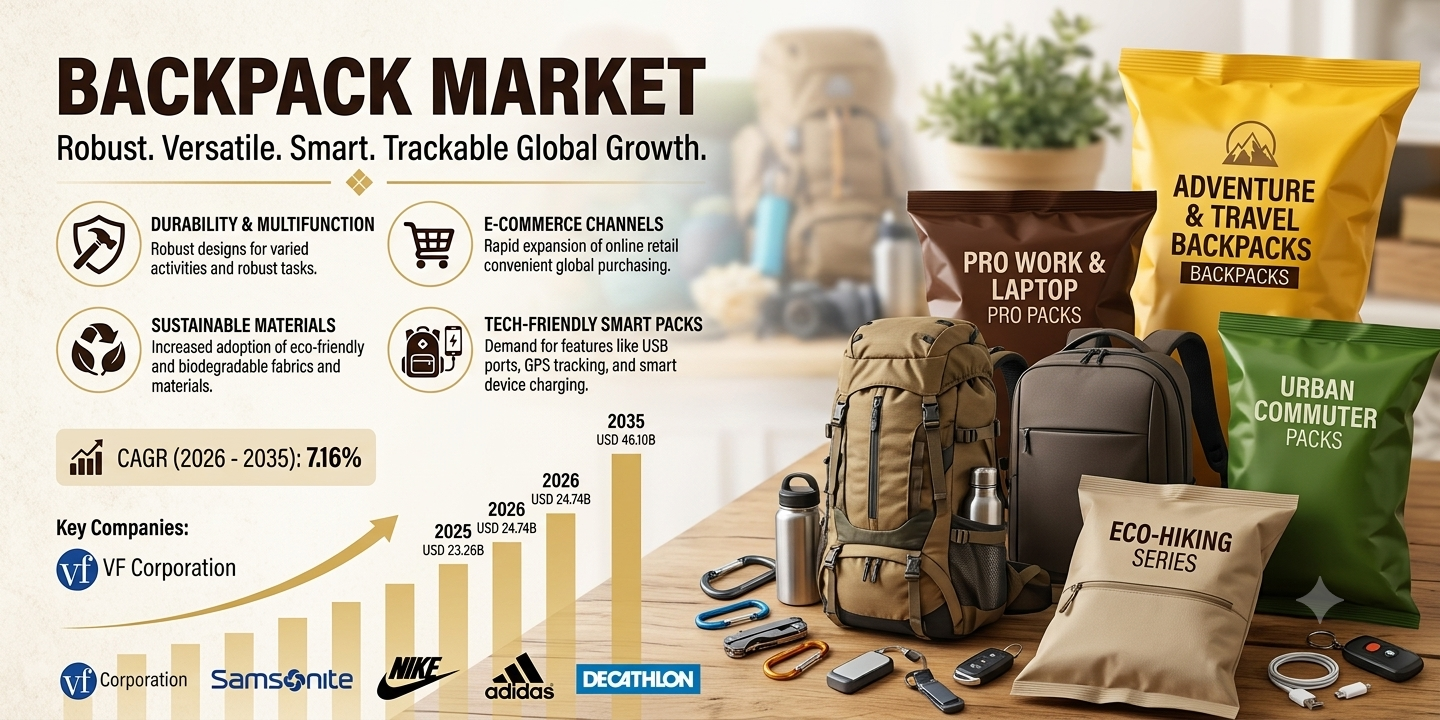
NEW YORK, NY, UNITED STATES, August 31, 2026 /EINPresswire.com/ -- The global Backpack Market is entering a period of sustained expansion as consumers increasingly seek products that combine convenience, durability, comfort, style, and multifunctionality. Backpacks have evolved beyond basic carrying accessories into versatile products designed for travel, commuting, education, outdoor recreation, sports, and everyday lifestyles. According to the supplied market outlook, the global Backpack Market is valued at USD 23.26 billion in 2025 and is expected to reach USD 24.74 billion in 2026, advancing to USD 46.10 billion by 2035 at a 7.16% CAGR from 2026 to 2035. The assessment covers product type, price point, end-user, distribution channel, and geography over the 2021–2035 study period.— Market Research Future (MRFR)
The evolving consumer preference for products that deliver both practical performance and contemporary design is becoming an important force behind industry development. Travel-oriented consumers want lightweight products with organized compartments, while students and professionals increasingly prefer backpacks capable of carrying laptops, tablets, documents, accessories, and personal essentials. Outdoor users, meanwhile, prioritize durability, weather resistance, ergonomic support, hydration compatibility, and specialized storage. This broad range of applications is allowing backpack manufacturers to address several consumer groups simultaneously and reduce reliance on a single end-use category.
Competitive Landscape:
Competition in the Backpack Market is shaped by a combination of global sportswear brands, luggage companies, outdoor specialists, lifestyle labels, and regional manufacturers. The companies supplied for this market assessment include:
▪️VF Corporation
▪️Samsonite
▪️Nike
▪️adidas
▪️Decathlon
▪️Thule
▪️Amer Sports
▪️Fenix Outdoor
▪️Osprey
▪️Deuter
▪️Herschel
▪️and Wildcraft.
These participants compete through different combinations of product innovation, brand recognition, pricing, distribution, sustainability, technical performance, and design.
Sportswear companies can leverage established brand communities and extensive retail networks, while luggage specialists can build on expertise in travel products. Outdoor-focused businesses can differentiate through technical performance, while lifestyle brands can compete through aesthetics and cultural relevance.
The competitive environment is therefore not based solely on price. Product durability, comfort, design identity, sustainability credentials, customer experience, and digital engagement can all influence consumer preference.
Backpack Market Outlook:
The global Backpack Market is undergoing a significant transformation as changing lifestyles influence how consumers select and use bags. Backpacks are increasingly positioned as lifestyle products rather than purely functional accessories. The modern consumer expects a product to perform across multiple environments, from an office commute in the morning to a weekend trip or outdoor excursion.
The market outlook supplied for this analysis indicates a valuation of USD 23.26 billion in 2025, with the industry projected to increase to USD 24.74 billion in 2026 and reach USD 46.10 billion by 2035. The anticipated CAGR of 7.16% during 2026–2035 reflects the continuing demand for versatile carrying solutions.
Several structural factors support this trajectory. Urbanization is encouraging demand for compact and ergonomic commuting products, while tourism and recreational travel are supporting demand for dedicated travel backpacks. At the same time, greater participation in hiking, camping, trekking, cycling, and other outdoor activities is creating opportunities for specialized designs.
Backpack Market Segmentation:
By Product Type
▪️Athletic: 55.7% share in 2025, driven by outdoor activities and performance features.
▪️Casual: 9.59% CAGR, supported by urban mobility and hybrid work trends.
By Price Point
▪️Economy: 51.2% share, led by school and institutional purchases.
▪️Mid-Range: USD 7.79 billion, driven by commuting and everyday use.
▪️Premium: 9.79% CAGR, supported by smart features and sustainable materials.
By End-User
▪️Adults: 63.8% share, fueled by commuting, travel, and recreation.
▪️Children: 10.24% CAGR, supported by rising enrollment and ergonomic designs.
By Distribution Channel
▪️Offline Retail: 60.4% share, benefiting from product trials and immediate availability.
▪️Online Retail: 10.13% CAGR, driven by wider product choices and direct brand access.
Changing Consumer Preferences Drive Product Innovation:
Consumer expectations have become more sophisticated, encouraging manufacturers to reconsider the conventional backpack design. A simple storage compartment is no longer sufficient for many buyers. Consumers increasingly look for products that help them organize multiple belongings while maintaining comfort and reducing physical strain.
Ergonomic construction has therefore become an important area of product development. Padded shoulder straps, breathable back panels, adjustable chest straps, structured compartments, balanced weight distribution, and lightweight construction can improve the user experience. These characteristics are particularly relevant for consumers who carry backpacks for extended periods.
A growing preference for multifunctionality is also influencing design. A single backpack may now serve as a work bag, travel accessory, personal organizer, and recreational product. Dedicated laptop compartments, cable-management spaces, bottle holders, concealed pockets, luggage pass-through systems, and expandable storage are examples of features that can increase everyday usability.
Style is equally important. Consumers increasingly expect functional products to complement their clothing and personal identity. As a result, manufacturers are combining technical performance with fashion-oriented silhouettes, colors, textures, and branding.
Get Full PDF Sample Copy of Report: (Including Full TOC, List of Tables & Figures, Chart) @
https://www.marketresearchfuture.com/sample_request/12033
Travel Segment Strengthens Industry Demand:
Travel remains one of the most important application areas within the Backpack Market. Changes in travel behavior, short-duration trips, business mobility, and leisure tourism are encouraging consumers to seek convenient alternatives to conventional luggage for certain journeys.
Travel backpacks appeal to users because they can provide flexible storage while keeping both hands free. Features such as multiple compartments, padded technology storage, compact dimensions, security pockets, and easy-access sections can make them suitable for airports, rail travel, road trips, and urban exploration.
The supplied market information identifies travel as a leading product category, while hiking and camping represent an especially dynamic area of demand. The distinction between these categories is becoming increasingly fluid. Travelers may choose outdoor-inspired backpacks for city trips, while outdoor enthusiasts may use technical backpacks during general travel.
Manufacturers are responding by introducing hybrid products capable of serving several purposes. These designs can appeal to consumers who do not want to purchase separate bags for commuting, business travel, and leisure activities.
Hiking and Camping Create New Opportunities:
The growing popularity of outdoor recreation is opening another significant avenue for backpack manufacturers. Hiking, camping, trekking, adventure tourism, and nature-based travel require carrying solutions capable of handling demanding conditions.
Outdoor consumers often place greater emphasis on material strength, weather protection, load distribution, ventilation, accessibility, and long-term durability. Technical backpacks may incorporate specialized compartments for hydration systems, clothing, food, navigation equipment, and other outdoor necessities.
The growth of outdoor lifestyles is also broadening the consumer base. Hiking is no longer limited to highly experienced outdoor enthusiasts. More casual participants are entering the category, creating demand for products that balance technical features with simplicity and affordability.
This trend is encouraging manufacturers to develop products across different price levels. Entry-level models can target occasional users, while premium products can focus on advanced materials, specialized construction, improved ergonomics, and greater durability.
Sustainability Becomes a Major Design Consideration:
Environmental awareness is increasingly influencing purchasing behavior across the consumer goods industry, and backpacks are no exception. Buyers are paying greater attention to the materials used in products, manufacturing practices, product lifespan, and end-of-life considerations.
Manufacturers are exploring recycled polyester, recycled nylon, responsibly sourced materials, lower-impact manufacturing processes, and longer-lasting product construction. Sustainability can also extend beyond materials. Designing products for durability can reduce replacement frequency and potentially lower resource consumption over a product's useful life.
The sustainability movement is creating both opportunities and challenges. Companies need to balance environmental objectives with performance, affordability, appearance, and durability. Outdoor consumers, in particular, may expect environmentally responsible products without compromising technical performance.
Smart Features Add a Technology Dimension:
Technology is gradually changing the functional capabilities of backpacks. Modern designs can include features intended to improve connectivity, organization, security, and convenience.
Smart backpack concepts may incorporate charging-related features, tracking technologies, anti-theft mechanisms, and dedicated compartments for electronic devices. These features are particularly relevant to students, business travelers, commuters, and digitally connected consumers.
The integration of technology is also changing the definition of functionality. Consumers increasingly carry smartphones, tablets, laptops, headphones, chargers, power banks, and other electronics. Backpacks designed around these devices can provide organized storage and additional protection.
However, technology integration must be carefully balanced. Additional components can increase weight, complexity, cost, and maintenance requirements. Successful products will therefore need to demonstrate practical value rather than simply adding technology for novelty.
Online Distribution Expands Consumer Access:
Digital commerce is reshaping the way backpacks are discovered and purchased. Online channels allow consumers to browse large product selections without geographical limitations. Product specifications, customer reviews, comparison tools, images, and videos can help shoppers evaluate products before purchasing.
For manufacturers, online platforms provide access to broader audiences and enable direct communication with consumers. Brands can use digital campaigns to demonstrate product functionality, showcase new designs, and communicate sustainability initiatives.
Social media is particularly influential among younger consumers. Visual content can demonstrate how a backpack performs during travel, commuting, fitness activities, or outdoor adventures. Influencer partnerships and user-generated content can further increase product visibility.
At the same time, physical stores remain important because backpacks are products that consumers may want to physically inspect. Trying on a backpack can help shoppers assess comfort, size, strap adjustment, weight distribution, and overall fit. Consequently, an omnichannel approach can provide brands with advantages across both digital and physical retail environments.
Price Point Creates Opportunities Across Consumer Groups:
The market's price structure allows manufacturers to serve a wide range of consumers. Entry-level backpacks can attract students, occasional travelers, and price-sensitive shoppers. Mid-range products can focus on durability, functionality, and everyday use. Premium backpacks can compete through advanced materials, technical construction, brand positioning, design, and specialized features.
Price differentiation is becoming increasingly important because consumers do not all evaluate backpacks using the same criteria. A student may prioritize affordability and laptop protection, while a professional traveler may value organization and appearance. An outdoor enthusiast may be willing to pay more for technical construction and durability.
This segmentation enables companies to create targeted product portfolios instead of relying on a single universal design.
Regional Market Dynamics:
Regional consumer behavior plays an important role in shaping demand. North America has historically represented a major backpack market, supported by outdoor recreation, commuting needs, travel, and strong consumer interest in branded products. The region's established retail infrastructure and e-commerce ecosystem also provide manufacturers with broad distribution opportunities.
Europe presents strong opportunities linked to sustainability, urban mobility, travel, and outdoor recreation. Consumers in several European markets place considerable emphasis on product quality, durability, responsible materials, and contemporary design. These preferences encourage brands to invest in environmentally conscious products and premium positioning.
Asia-Pacific represents an important growth opportunity because of urbanization, rising consumer purchasing power, expanding tourism, increasing outdoor participation, and the development of organized retail and digital commerce. The region's diverse consumer base also creates opportunities for localized product strategies.
Emerging markets across the Middle East, Africa, and Latin America offer additional potential as younger populations, urban lifestyles, tourism, education, and recreational activities contribute to demand for functional carrying products.
Product Innovation Will Remain Central:
Innovation is expected to remain one of the most important competitive tools throughout the forecast period. Manufacturers are likely to continue exploring lighter materials, improved ergonomics, better compartmentalization, modular construction, sustainable fabrics, and technology-enabled features.
Customization represents another potential area of differentiation. Consumers increasingly value products that reflect individual preferences. Personalized colors, graphics, monograms, modular accessories, and configurable components can help brands build stronger emotional connections with buyers.
The combination of personalization and digital commerce could be particularly powerful. Online platforms can provide consumers with greater choice while enabling brands to collect feedback about preferred colors, sizes, features, and designs.
Opportunities for Manufacturers:
The forecast period presents several opportunities for industry participants. Sustainable materials can provide a pathway toward differentiation as environmental considerations become increasingly important. Smart functionality can help brands address the needs of digitally connected consumers. Outdoor recreation provides opportunities for specialized products, while urban commuting supports demand for ergonomic and multifunctional designs.
Education is another relevant opportunity. Students require products that can accommodate technology, books, stationery, and personal belongings. Partnerships with schools, universities, sports organizations, and institutions can create customized product programs.
Travel companies and hospitality businesses can also represent potential B2B opportunities through branded or co-branded backpacks for employees, customers, events, and promotional programs.
Challenges Facing the Industry:
Despite positive prospects, manufacturers must address several challenges. Rising material costs, supply-chain disruptions, changing consumer expectations, and intense competition can affect profitability.
Sustainability also introduces complexity because environmentally responsible materials may involve higher sourcing or processing costs. Companies need to communicate sustainability claims transparently while ensuring that products continue to meet performance expectations.
Another challenge is product differentiation. The basic backpack format is mature, meaning brands must continually find meaningful ways to stand apart. Excessive feature additions can increase cost and weight without necessarily improving the customer experience.
Future Outlook:
The Backpack Market is positioned for continued development as travel, urban mobility, outdoor recreation, sustainability, digital commerce, and product innovation converge. The supplied forecast points to an increase from USD 23.26 billion in 2025 to USD 46.10 billion by 2035, representing a 7.16% CAGR during 2026–2035.
Future growth is likely to be driven less by the basic need to carry belongings and more by the increasing demand for products that solve specific lifestyle requirements. Backpacks are becoming platforms for organization, mobility, comfort, technology integration, personal expression, and sustainable consumption.
Manufacturers that successfully combine these attributes can strengthen their competitive positions. The strongest opportunities are likely to emerge where product design responds directly to consumer behavior, whether through travel-friendly organization, outdoor performance, commuter ergonomics, sustainable materials, or smart functionality.
Frequently Asked Questions?
What is driving the Backpack Market?
Demand is being supported by travel, outdoor recreation, urban commuting, multifunctional product requirements, sustainability, and technological innovation.
What backpack categories offer strong opportunities?
Travel backpacks remain important, while hiking and camping products offer opportunities linked to growing participation in outdoor activities.
How is sustainability influencing backpack design?
Manufacturers are exploring recycled and lower-impact materials, durable construction, and production approaches intended to reduce environmental impact.
Why are smart backpacks gaining attention?
Connected features such as device-oriented organization, charging functionality, tracking, and security solutions can address the needs of technology-focused consumers.
Browse More Reports:
All Year Gifting Market:
https://www.marketresearchfuture.com/reports/all-year-gifting-market-16098
Pet Grooming Market:
https://www.marketresearchfuture.com/reports/pet-grooming-market-18871
Fishing Nets Market:
https://www.marketresearchfuture.com/reports/fishing-nets-market-21822
Hiking Accessories Market:
https://www.marketresearchfuture.com/reports/hiking-accessories-market-32155
Electric Kettle Market:
https://www.marketresearchfuture.com/reports/electric-kettle-market-33139
Market Research Future
Market Research Future
+1 855-661-4441
email us here
Legal Disclaimer:
EIN Presswire provides this news content "as is" without warranty of any kind. We do not accept any responsibility or liability for the accuracy, content, images, videos, licenses, completeness, legality, or reliability of the information contained in this article. If you have any complaints or copyright issues related to this article, kindly contact the author above.
